


Why Choose Us
Customization
Transform your industrial machinery with our cutting-edge motor customization solutions! Boost efficiency, optimize performance, and maximize output with tailored engineering upgrades designed to meet your unique production needs.
Quality
"Elevate your expectations with our premium motor quality! Engineered to exceed industry standards, our motors are crafted with precision and care to deliver unmatched performance and durability. Built to withstand the toughest conditions, our motors ensure reliable operation day in and day out, keeping your equipment running smoothly and efficiently. Experience the difference with our commitment to excellence – choose superior motor quality for your applications and drive with confidence."
Achievement
MCM sales performance in the engineering industry is truly commendable, showcasing remarkable resilience, strategic vision, and consistent growth amidst challenging market conditions.
Service
Professional technical personnel provide consultation before and during sales, and 24-hour after-sales service support.
What is Squirrel cage induction motor
Squirrel cage induction motor is a common type of electric motor that is commonly used in a variety of applications, ranging from household appliances to industrial equipment. Its design is relatively simple, with its internal structure consisting of a fixed outer core surrounding an inner rotor. This rotor, usually composed of copper or aluminum conductor strips, is called a "cage," which is where the motor gets its name.
Related Product

MILL AC Motor is an AC electric motor commonly used in various industrial applications. This kind of motor is powered by AC power and generates rotational force through AC power to drive mechanical equipment to operate. MILL AC Motor has many advantages, such as high efficiency, high reliability, low maintenance cost, etc. They are commonly used to drive fans, pumps, compressors, conveyor belts and other industrial equipment.

Aluminum Foil Rolling Mill Motor
Aluminum foil rolling mill motor is one of the key components used to drive aluminum foil rolling mill. It is usually designed as an efficient, stable and durable motor to ensure that the aluminum foil can be accurately rolled and processed during the production process. Such motors typically feature high torque output and precise speed control to ensure stability and accuracy during production.

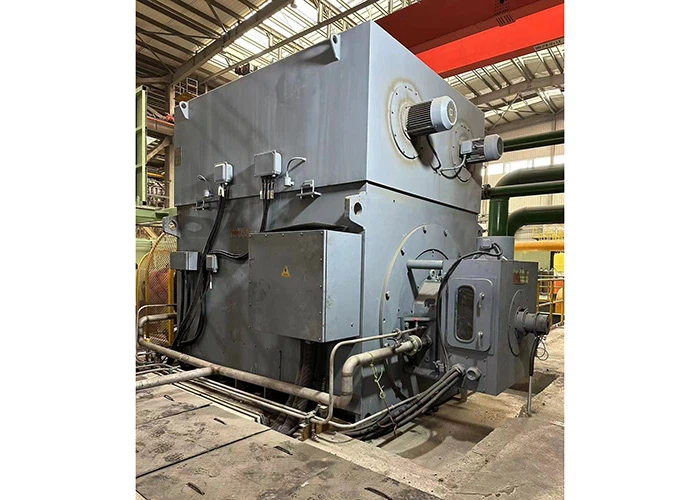
High Voltage Cage AC Motor is a common type of AC motor commonly used in industrial and commercial applications. The design of this motor is simple and efficient, making it suitable for applications requiring high power output. High Voltage Cage One of the main features of AC Motor is its high voltage requirement, usually above several thousand volts. This high voltage allows the motor to provide greater power output during operation, making it suitable for applications requiring high efficiency and performance.
Synchronous Variable Frequency Motor
Synchronous Variable Frequency Motors is an advanced motor technology that combines the advantages of synchronous motors and frequency converters. This kind of motor can adjust the speed and output power as needed, thereby improving efficiency and reducing energy consumption.

Heavy Duty AC Motor is a powerful and durable AC motor commonly used in industrial applications requiring high power and long operation times. This type of motor is designed to withstand higher loads and more frequent use, making it very popular in a variety of industrial settings.

Centrifugal compressor Motor is a dynamic machine that transfers kinetic energy to the gas through the action of a rotating impeller to increase the pressure of the gas. These compressors are widely used in various industries such as oil and gas, chemical processing, power generation and refrigeration.

High speed motor is an electric motor used to achieve high-speed rotation. These motors are often used in applications that require fast rotation, such as fans, turbines, compressors, etc. High speed motors generally have high efficiency, high power density and low maintenance costs. They can play an important role in industry, aerospace, automotive and other fields.

High Voltage Induction Motors are a common type of electric motor typically used in industrial applications where high power output is required. This type of motor drives mechanical equipment to operate by generating rotational force between the rotor and stator by inducing electric current.

High voltage slip ring motors are advanced motors designed to handle high voltage applications. Designed with advanced features, they are ideally suited for a variety of industrial applications and offer a wide range of advantages. Highly reliable, durable and efficient, these motors provide superior performance even in the harshest environments.
Advantages of Squirrel cage induction motor
High efficiency
Cage induction motor adopts the principle of induction motor, the conductor on the rotor generates induction current, thus realizing the conversion of electric energy. Its conversion efficiency is more than 90%, which is higher than the 70% of DC generator, enabling the power generation efficiency to be guaranteed.
Reliability
Cage induction motor adopts air gap between rotor and stator, there is no mechanical contact, and the low quality of insulation material will not lead to equipment failure. Meanwhile, the rotor winding is in the form of aluminum short circuit, which has higher reliability and better heat dissipation performance than other winding types, ensuring that the equipment is not easy to be damaged.
Stability
The operational stability of cage induction motor is superior to other types of generators. It has strong anti-disturbance ability and frequency regulation ability, which can automatically adjust the voltage and frequency during the operation of the equipment to maintain constant power generation and power output to ensure the stable operation of the power grid.
Simple maintenance
Cage induction motor does not require frequent maintenance. Except for the regular replacement of bearings and stator connecting bolts, the equipment basically needs no other maintenance work, thus reducing the maintenance cost and difficulty of equipment operation.
Squirrel cage induction motor Working Principle
When a 3 phase supply is given to the stator winding it sets up a rotating magnetic field in space. This rotating magnetic field has a speed which is known as the synchronous speed.
This rotating magnetic field induces the voltage in rotor bars and hence short-circuit currents start flowing in the rotor bars. These rotor currents generate their self-magnetic field which will interact with the field of the stator. Now the rotor field will try to oppose its cause, and hence rotor starts following the rotating magnetic field.
The moment rotor catches the rotating magnetic field the rotor current drops to zero as there is no more relative motion between the rotating magnetic field and rotor. Hence, at that moment the rotor experiences zero tangential force hence the rotor decelerates for the moment.
After deceleration of the rotor, the relative motion between the rotor and the rotating magnetic field reestablishes hence rotor current again being induced. So again, the tangential force for rotation of the rotor is restored, and therefore again the rotor starts following rotating magnetic field, and in this way, the rotor maintains a constant speed which is just less than the speed of rotating magnetic field or synchronous speed.
Slip measures the speed difference between the rotating magnetic field and the rotor. The rotor current frequency equals the slip multiplied by the supply frequency.
Squirrel cage induction motor Construction
Stator
It consists of a 3 phase winding with a core and metal housing. Windings are such placed that they are electrically and mechanically 120o apart from in space. The winding is mounted on the laminated iron core to provide low reluctance path for generated flux by AC currents.
Rotor
It is the part of the motor which will be in a rotation to give mechanical output for a given amount of electrical energy. The rated output of the motor is mentioned on the nameplate in horsepower. It consists of a shaft, short-circuited copper/aluminum bars, and a core.
The rotor core is laminated to avoid power loss from eddy currents and hysteresis. Conductors are skewed to prevent cogging during starting operation and gives better transformation ratio between stator and rotor.
Fan
A fan is attached to the back side of the rotor to provide heat exchange, and hence it maintains the temperature of the motor under a limit.
Bearings
Bearings are provided as the base for rotor motion, and the bearings keep the smooth rotation of the motor.
Squirrel cage induction motor are commonly used in many industrial applications. They are particularly suited for applications where the motor must maintain a constant speed, be self-starting, or there is a desire for low maintenance.
These motors are commonly used in:
• Centrifugal pumps.
• Industrial drives (e.g. to run conveyor belts).
• Large blowers and fans.
• Machine tools.
• Lathes and other turning equipment.
According to the number of stator phases
• Single-phase cage induction motor
• Three-phase cage induction motor
• Multi-phase cage induction motor
According to rotor structure
• Single-phase squirrel-cage induction motor
• Double squirrel cage induction motor
• Deep groove induction motor
It should be noted that the rotor structure of cage induction motor is similar to that of a squirrel cage, which consists of many parallel copper bars, and this is the reason for its name.
According to the different ways of protection of the casing
• Open type cage induction motor
• Leak-proof cage induction motor
• Closed cage induction motor
• Explosion-proof cage induction motor
This categorization mainly focuses on the design of motor casing to meet different working environment and protection requirements.
According to the capacity of the motor
• Micro motor cage induction motor
• Small-sized cage induction motor (0.6-100 kW)
• Medium-sized cage induction motor (100-1000 kW)
• Large-sized cage induction motor (over 1000 kW)
The capacity categorization reflects the power of the motor and the applicable scenarios; large cage induction motors are usually used in industrial applications that require high power output.
By voltage
• High Voltage Cage Induction Motors
• Low Voltage Cage Induction Motors
The voltage classification is mainly related to the magnitude of the voltage applied to the stator windings of the motor. High-voltage cage induction motors are usually used in applications requiring high voltage input.
Factors to Consider When Selecting a Cage Induction Motor
Motor capacity
The capacity of the motor must be able to drive the load and run for a long period of time without overheating at the various speed points required by the production process.
The motor capacity and starting torque must be greater than the power and starting torque required by the load.
In the case of a 10% to 15% drop in supply voltage, the torque can still meet the needs of the start or operation.
If the motor does not work continuously for a long time each time at the lowest frequency, the original motor can be retained; on the contrary, the capacity of the motor should be increased by one stop.
Number of pole pairs
The number of magnetic pole pairs of the motor is generally determined by the production process and not easily changed.
General inverter is designed and manufactured for 4-pole (2p=4 poles) motors. Therefore, when the motor is not 4-pole, the capacity of the inverter must be calibrated with current.
Operating frequency range
The operating frequency range of the motor should include the load requirements on the speed range.
Certain general-purpose inverters have unsatisfactory low-speed operating characteristics, so the higher the minimum frequency of speed, the better.
When using a frequency above the industrial frequency, it is important to verify that it is within the maximum permissible frequency range of the motor.
Heat dissipation capability
When an inverter is used, the heat dissipation capability of the motor deteriorates at low speed operation. Therefore, it may be necessary to set a constant-speed cooling fan to improve heat dissipation during continuous operation below the rated speed.
Load type
Select the appropriate motor model according to the type and characteristics of the actual load.
Power factor
The power factor of induction motors is generally between 0.8 and 0.9. If the power factor of the load is low, it is necessary to choose a larger capacity motor.
Overload capacity
Induction motors have a certain overload capacity, but the overload time should not be too long. It is necessary to choose a motor with strong overload capacity to cope with unexpected conditions.
Structural characteristics
The structure of cage induction motor is relatively simple, the manufacturing cost is low and the maintenance is relatively simple. However, it is necessary to choose the suitable structure according to the specific application.
Usage scenarios
Cage induction motors are widely used in various industrial fields, such as petroleum, chemical industry, iron and steel, electric power and so on. It is necessary to choose the suitable motor according to the specific application scenario.
Our factory
WUXI MCM ELECTRIC MACHINERY CO.,LTD was established on October 18, 2011. Its registered address is located at Lot E15, Phase 5, Shuofang Industrial Concentration Zone, Xinwu District, Wuxi City (within Lidong Industrial Company). The legal representative is Dong Xiaofang. The business scope includes the manufacturing, processing, sales and technology development and technical services of motors; the research and development, design, processing and sales of industrial automatic control systems; the import and export of self-operated various commodities and technologies (the state limits the operation of companies or prohibits import and export) Except for goods and technologies).

video
FAQ
Hot Tags: YPKK Series Squirrel Cage Induction Motor, China YPKK Series Squirrel Cage Induction Motor manufacturers, suppliers, factory